Sovereignty at Stake
The Securitization of Crime as an Instrument of Power
Delmo Arguelhes and William Ferreira
Abstract
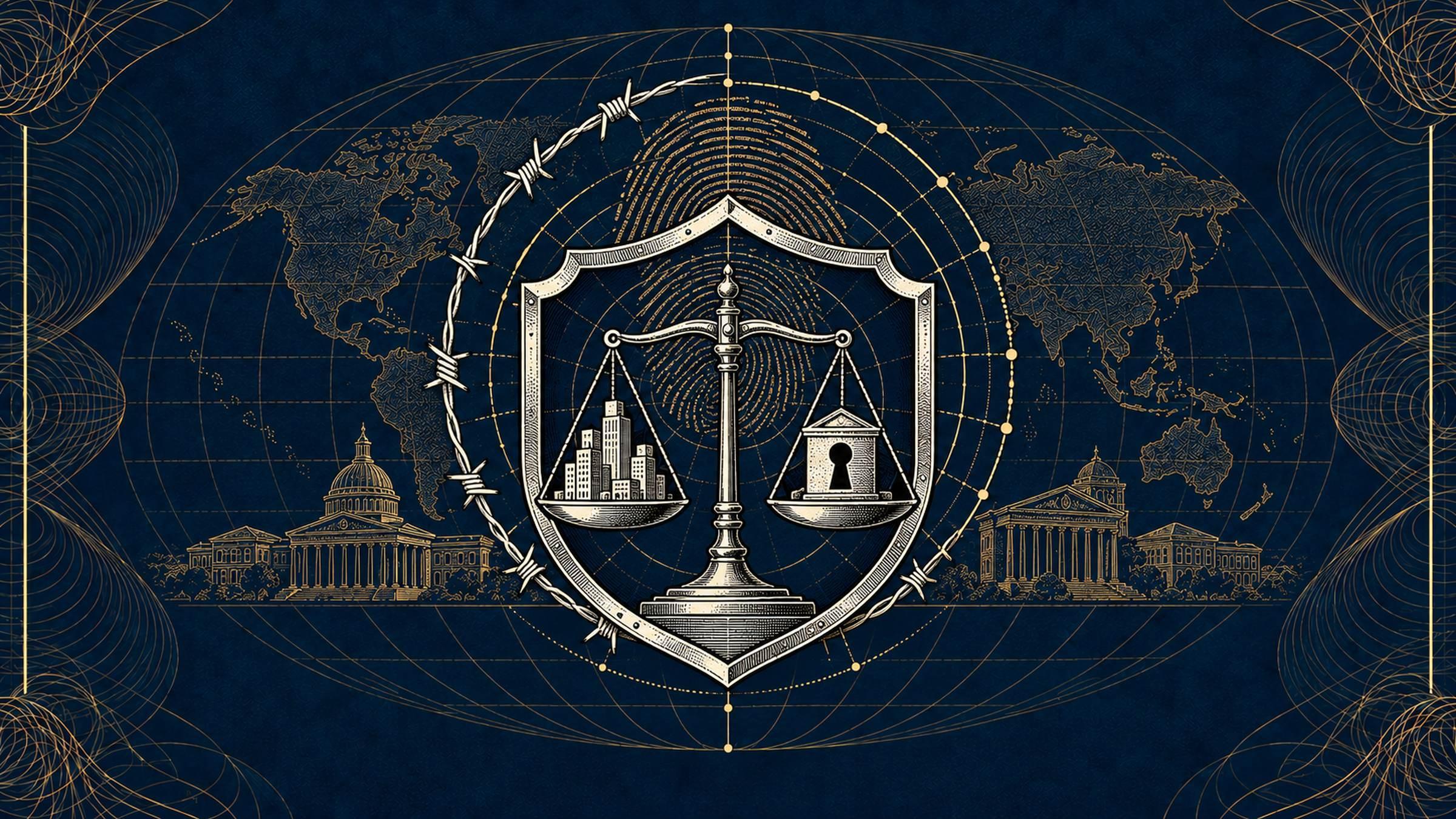
The securitization of crime in Latin America, orchestrated by Washington, goes beyond the fight against drug trafficking, revealing itself to be an imperial mechanism for eroding the sovereignty of peripheral nations. Under the guise of control, the United States imposes a financial stranglehold that subordinates nations to its hegemony. To counter such interference, it is imperative to mount a multidimensional counter-offensive: epistemic resistance, the strengthening of regional blocs and economic shielding are essential weapons against this disguised political domination.
Introduction
As we revisit Eric Hobsbawm’s “short twentieth century,” we understand that the distinction between civil order and barbarian chaos figured, in the cartography of classical diplomacy, as an apparently indelible boundary. Yet we observe that, in the opening decades of the present millennium, this analytical clarity has dissolved. The legal reclassification of criminal factions such as the Primeiro Comando da Capital (PCC) and the Comando Vermelho (CV) under the status of Foreign Terrorist Organizations (FTOs) by the U.S. administration does not appear to us as an isolated historical accident, but rather as an emblematic symptom of an era of programmed uncertainty.
We find ourselves confronted with the agony of national sovereignties, increasingly compressed by the voracity of global capital, which, in its unrestrained expansion, no longer tolerates the constraints imposed by the traditional frameworks of the nation-state. We understand that the genesis of this metamorphosis is not confined to the halls of diplomacy, but also unfolds in the silence of stock exchanges and on the peripheries of capitalism, spaces in which violence is produced and reproduced on an industrial scale.
We understand that organized crime has been categorized predominantly as an endogenous by-product of social dysfunctions. Yet the imperative need of capital to capture financial flows and exercise control over marginal territories has required a narrative reconfiguration of this problem. Securitization, as carried out by the United States, operates as a mechanism of semantic and political conversion: urban violence is transmuted into an existential threat to national security. Under this pretext, we maintain that the hegemonic center does not, in fact, seek the eradication of drug trafficking; on the contrary, it redraws the rules of the game to ensure that no flow of capital—including illicit capital—escapes its scrutiny, sanction, or direct control. In this way, we note that crime ceases to be treated strictly as a matter of public order and becomes consolidated as an issue intrinsic to territorial and financial expansion.
In this article, we propose to dissect this process, demonstrating how truthfulness has become the first casualty of contemporary geopolitical warfare. We turn to Michel Foucault and Antonio Gramsci not as dogmas, but as essential analytical frameworks for navigating a highly complex landscape in which legal classification operates, fundamentally, as a vector for the projection of power. We proceed from the premise that truth is not constituted as a given of reality, but rather as a construction forged and imposed by those who hold hegemony. If, as Michel Foucault would suggest, the “truth of truth is war,” we understand the designation of “terrorist” as the new artillery¹ of an era that has replaced the conventional battlefield with the sanctions lists of the U.S. Department of the Treasury. What is at stake, we maintain, is the systematic erosion of Latin American sovereignties in the face of an imperialism that, under the mantle of public security, consolidates its material and ideological hegemony on the hemispheric chessboard.
To unveil the mechanisms underlying this reclassification, we adopt an analytical approach that combines the density of critical theory with the rigorous analysis of strategic policies. We examine how the mutation of the Western episteme concerning the criminal phenomenon converges with Gramscian strategies of war of maneuver and war of position. In Section I, we map the anatomy of securitization and the knowledge–power nexus, scrutinizing the institutional and financial dynamics that reveal the logic of external intervention, as well as the role of corporate media as a legitimizing echo chamber for this apparatus. Section II, in turn, proposes prescriptive guidelines grounded in epistemic resistance, the revitalization of regional multilateral mechanisms, and the shielding of our economic structures. Sovereignty in the twenty-first century transcends the safeguarding of physical borders; it rests, above all, on the capacity to produce autonomous meanings as to what constitutes a threat. We understand that the deconstruction of this exogenous discourse is a sine qua non condition for recovering our prerogative to define the contours of our own security and to resist the transformation of the peripheries into laboratories of imperial control, since the struggle for sovereignty is configured, in the contemporary era, as the struggle over the very definition of reality.
Section I: Descriptive
To understand the nature of this new security episteme, we must first recall the historical frameworks that preceded it. The concept of “terrorism” has never been a neutral legal category; rather, it is a politically malleable label. Terror in the political sphere is defined as a mechanism for imposing one’s will upon others through extralegal violence.
Initially practiced as an act of state political power, from the nineteenth century onward the term came to be applied primarily to anarchists who represented a threat to the European monarchical apparatuses; in the twentieth century, it came to encompass national liberation movements that challenged colonial rule. At each of these moments, the attribution of “terrorist” versus “criminal” was grounded not solely in the materiality of the acts, but in the relational position of the observer vis-à-vis state power. The historical lesson we invoke is clear: naming the enemy constitutes the first move toward excluding it from the ordinary legal regime.
In formulating the concept of episteme, Michel Foucault revealed the subterranean mechanics that organize practices of labeling: a fundamental cultural code that delimits what, in each era, can be recognized as truth. In the present, the episteme of global security has undergone a profound mutation. What was previously framed as a policing problem—organized crime—has been discursively reconfigured as a threat to civilization itself. We maintain that such a discursive shift is not a mere rhetorical contingency, but responds to concrete geopolitical interests; it allows, for example, extraterritorial interventions by powers such as the United States in contexts in which the former legal-criminal demarcation of ordinary crime would render them more problematic. We argue, therefore, that the so-called “truth” of narcoterrorism functions as an artifact of war: contemporary politics has incorporated the logic of war through semantic and institutional means, converting discourses into normative and operational pretexts for state action beyond ordinary legal frameworks.
The object of the police, as Foucault aptly reminds us, is infinite. Such a dissolution of limits makes possible an operational gray zone, which appears as just and necessary. Appearance, here, stands as a counterpoint to the phenomenon.²
The legal-historical framework that structured this narrative reconfiguration dates back to Section 219 of the United States Immigration and Nationality Act (INA).³ This legal provision articulates the normative ambiguity that makes possible the reclassification of criminal factions as “terrorists,” a process conditioned by domestic political dynamics—electoral campaigns and foreign-policy orientations—more than by purely legal criteria. We maintain that this transmutation requires a technical-institutional apparatus of legitimation. In this regard, the U.S. Intelligence Community—with the FBI and CIA occupying central positions—operates an analytical convergence aimed at assessing three strategic parameters: (i) the delimitation of “foreign sovereignty”; (ii) the definition of what constitutes “engagement in terrorist activity”; and (iii) the characterization of what constitutes a “threat to U.S. national security.” We argue that the fluidity of these parameters favors an expansive security policy in which legal and conceptual categories are instrumentalized to justify interventions beyond national borders and the limits of ordinary criminal law. Consequently, the very language of law and intelligence is transformed into an operational tool: it not only describes, but performs the political conversion of the enemy.
Subscriber Access
Continue reading Global Diplomacy
- Full access to every article in the current issue
- Download and print any article
- The complete archive as each issue is published
Topics
How to cite this article
Delmo Arguelhes and William Ferreira, “Sovereignty at Stake: The Securitization of Crime as an Instrument of Power,” Global Diplomacy 1, no. 1 (2026), https://globaldiplomacy.us/sovereignty-at-stake-the-securitization-of-crime-as-an-instrument-of-power.
Chicago Manual of Style, notes form